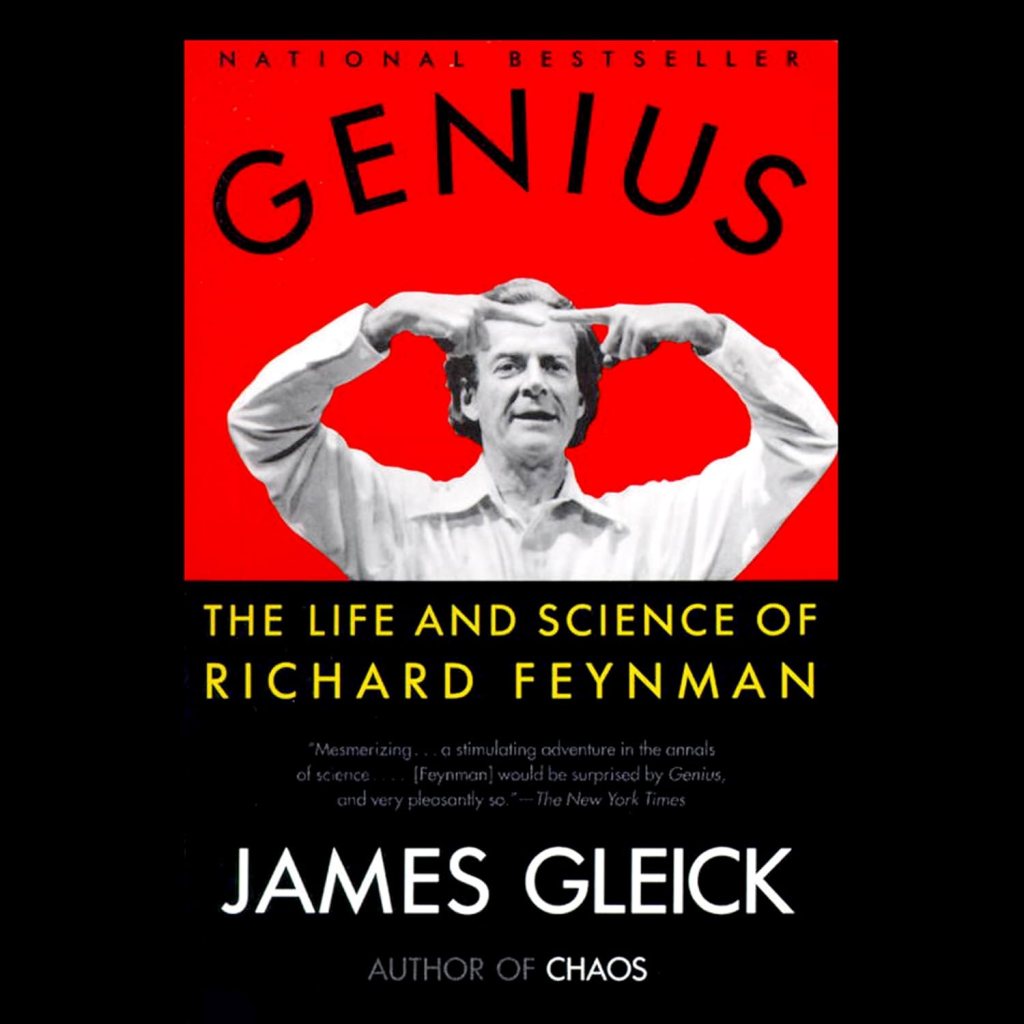
In reading or listening to anything on 20th century physics, Richard Feynman and his physics play a prominent role. With this in mind, I listened to Genius: The Life and Science of Richard Feynman.
When we think of scientific genius in the 20th century, Richard Feynman stands out not just for his intellect but for transforming how physics is practiced, taught, and imagined. James Gleick’s Genius: The Life and Science of Richard Feynman offers a deep dive into Feynman’s professional contributions, focusing on his revolutionary ideas and scientific collaborations.
The Feynman Revolution in Physics
🔬 Quantum Electrodynamics (QED)
At the heart of Feynman’s legacy is his work on quantum electrodynamics—the theory of how light and matter interact. Feynman reimagined the field using a unique “sum over histories” method, also known as the path integral formulation. This intuitive model allowed physicists to compute probabilities by considering all possible paths a particle could take.
His crowning innovation was the Feynman diagram, a visual tool that turned complex mathematical integrals into pictures. These diagrams became the lingua franca of particle physics and a foundational technique still used today.
Feynman’s contributions earned him a share of the 1965 Nobel Prize in Physics, alongside Julian Schwinger and Sin-Itiro Tomonaga, who arrived at similar conclusions using different methods.
Beyond Particles: Models and Methods
🧩 The Parton Model
Feynman’s investigations at SLAC National Accelerator Laboratory (“SLAC”) into deep inelastic scattering led to the development of the parton model—an early conceptualization of substructures within protons, later identified as quarks and gluons. This work laid the groundwork for quantum chromodynamics and our modern understanding of particle physics.
📘 The Feynman Lectures
In the 1960s, Feynman co-authored The Feynman Lectures on Physics, an extraordinary educational resource that emphasized clarity, elegance, and curiosity over rote learning. It remains a staple in physics classrooms worldwide.
Scientific Collaborations That Changed Everything
Feynman’s success was deeply intertwined with the brilliant minds around him:
- Hans Bethe, his wartime mentor at Los Alamos, played a crucial role in refining Feynman’s ideas and championing his work.
- Freeman Dyson provided the mathematical formalism that helped legitimize Feynman diagrams in the broader physics community.
- Murray Gell-Mann, famed for the quark model, engaged in lively exchanges with Feynman as they each probed the deep structure of matter.
Together with Julian Schwinger and Sin-Itiro Tomonaga, Feynman formed a triumvirate of minds whose differing methods converged on the same quantum truths.
A Legacy That Endures
Feynman’s approach to science was defined by curiosity, rigor, and playfulness. He insisted on deep understanding over memorization and fostered a culture of joyful exploration.
His tools—particularly Feynman diagrams and path integrals—reshaped physics and bridged the gap between theory and computation. His teaching methods continue to influence science communication and pedagogy.
Final Thoughts
Feynman didn’t just solve problems—he changed how problems were approached. Gleick’s biography reminds us that genius isn’t just brilliance; it’s also about generosity, collaboration, and a relentless drive to understand the universe.
If you’re a physicist, educator, or lifelong learner, Richard Feynman’s life is a call to approach knowledge with both precision and wonder.
 DeAngelis Family Tech Interests