I have always been interested in computation and information, which attracted me to this book. I found Adventures of a Computational Explorer, interesting, though Wolfram’s style and egotism wore thin after a while. Towards the end I found myself skimming more than reading. Though the various software programs he developed seem effective enough, I am not inclined to try any of them. Nonetheless, I thought sharing a summary of this book worth doing.
Wolfram asks “What if the universe is just a computation unfolding?”
In Adventures of a Computational Explorer, Stephen Wolfram invites readers on a journey through a life driven by this question. From foundational discoveries in cellular automata to advising on the science behind the film Arrival, Wolfram’s path is one of relentless curiosity — and a firm belief in the power of computation to explain just about everything.
Thinking Like a Computer
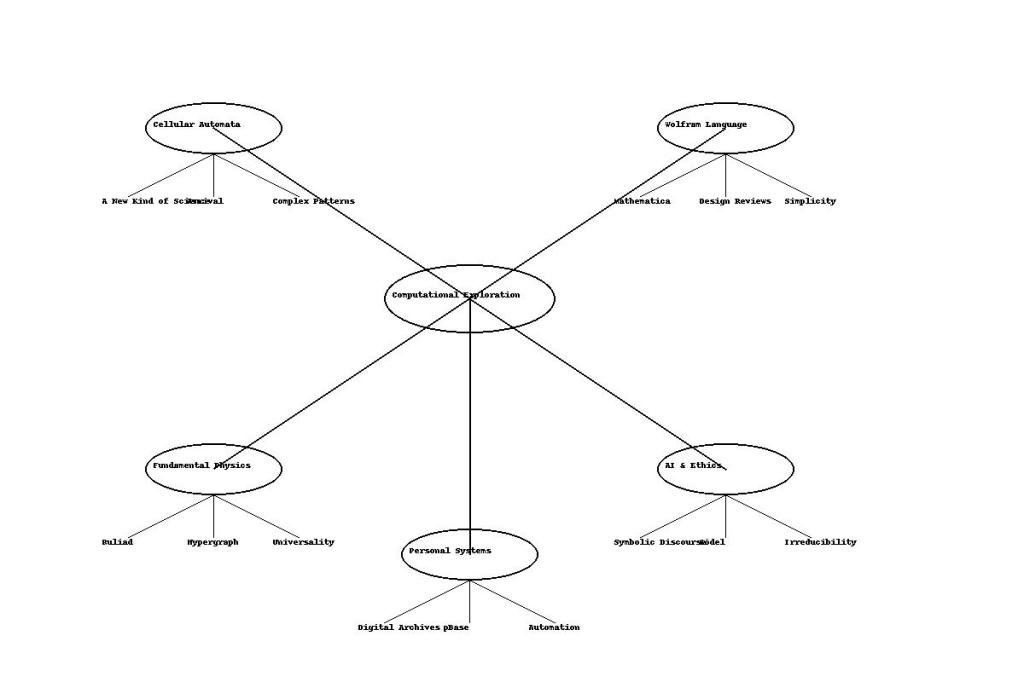
Whether he’s designing Mathematica, exploring AI ethics, or constructing theories about the fabric of space and time, Wolfram returns again and again to one central idea: simple rules can produce rich complexity. This idea, rooted in his study of cellular automata, lays the groundwork for his broader scientific project, including A New Kind of Science and the concept of the “Ruliad” — a universe of all possible computations.
From Code to Cosmos
Wolfram doesn’t just theorize; he builds. His Wolfram Language is an effort to make computational thinking executable — a bridge from abstract ideas to working programs. And in doing so, he reveals how software design mirrors scientific discovery: it’s not about adding features, but about stripping things down to their essence.
Even his reflections on AI ethics are shaped by this worldview. Rather than hand-coding morality, Wolfram suggests we might teach machines through symbolic computation — a language that can encode values and context as computable structures.
Designing a Productive Life
Wolfram’s personal infrastructure: a well-ordered digital life of folders, databases, automated scripts, and livestreams. His design philosophy — refine, simplify, systematize — doesn’t stop at software. It becomes a lifestyle.
Why It Matters
Wolfram’s adventures aren’t just technical. They’re philosophical. They ask us to reimagine what’s fundamental. To see the world as computation. And to build tools that let us explore that world more deeply, more creatively, and more rigorously than ever before.
 DeAngelis Family Tech Interests