With the start of gardening season, I thought it appropriate to summarize what I believe to be the best introductory book on permaculture. Gaia’s Garden: A Guide to Home-Scale Permaculture.

Gaia’s Garden by Toby Hemenway is widely regarded as the most accessible and inspiring introduction to permaculture available today. Designed for gardeners, homeowners, and sustainability enthusiasts, it offers practical, scalable strategies to turn backyards into resilient ecosystems that work with nature, not against it.
The Ethics and Principles of Permaculture
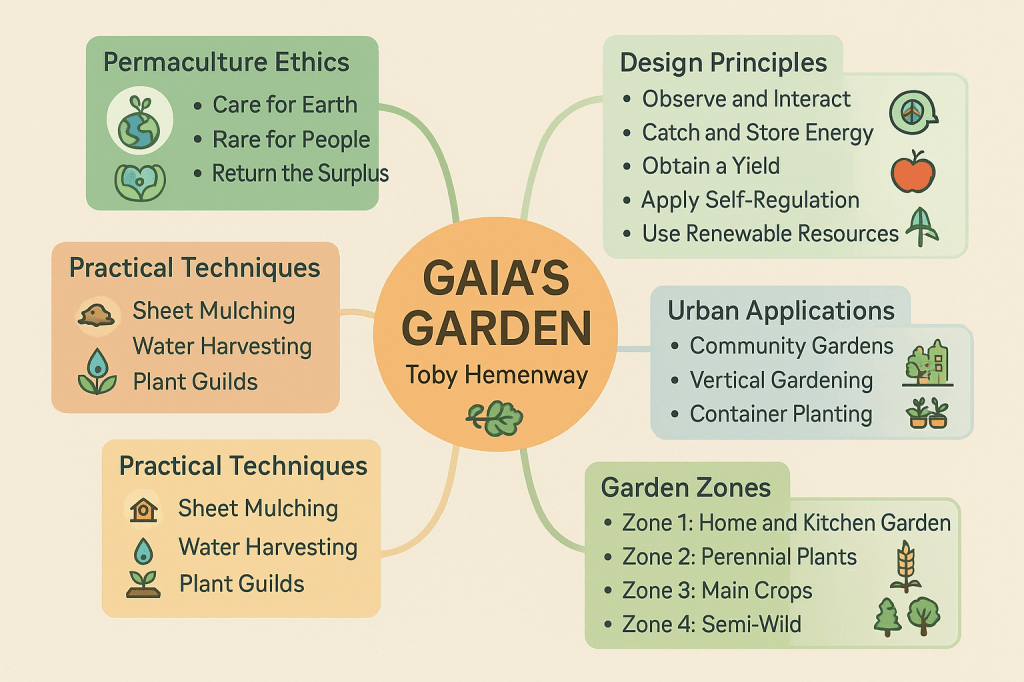
Permaculture is built on three core ethics:
- Care for the Earth – recognizing the planet as a living, interconnected system.
- Care for People – ensuring all people have access to the resources necessary to survive and thrive.
- Fair Share (Return the Surplus) – reinvesting excess to support the first two ethics.
Supporting these ethics are principles such as:
- Observe and interact
- Catch and store energy
- Obtain a yield
- Apply self-regulation and accept feedback
- Use and value renewable resources
Starting With Patterns
Nature works in patterns—branching in trees and rivers, spirals in shells, waves in weather. Recognizing and mimicking these natural designs help gardeners build more efficient systems. Hemenway encourages the reader to analyze their own site with a permaculture lens before making changes.
Building Healthy Soil
Healthy soil is the foundation of a productive garden. The book emphasizes:
- Composting
- Sheet mulching (a technique that mimics natural forest floors)
- Encouraging soil organisms like earthworms and fungi
- Avoiding synthetic inputs
Water-Wise Gardening
Water is a critical resource. Hemenway describes methods for:
- Capturing rainwater via swales and rain gardens
- Reducing runoff
- Storing water in the soil through organic matter and strategic contouring
Plant Guilds and Polycultures
Rather than isolated monocultures, permaculture thrives on plant guilds—groups of plants that support one another. For example, the “apple guild” might include:
- Apple tree (canopy and crop)
- Comfrey (nutrient accumulator)
- Garlic (pest repellent)
- Clover (nitrogen fixer)
These communities enhance biodiversity and resilience.
Zones and Sectors
Permaculture uses zoning to prioritize placement:
- Zone 1: Closest to the home – herbs, salad greens, daily-use plants
- Zone 2: Perennials, compost bins, small livestock
- Zone 3: Staple crops, orchards
- Zone 4: Forage and managed woodland
- Zone 5: Wild/natural area for observation
Sectors relate to external forces like sun, wind, and water and guide placement and design.
Urban and Suburban Permaculture
Hemenway devotes chapters to applying permaculture in cities and suburbs. He challenges the notion that permaculture is only for rural areas and provides:
- Examples of front-yard gardens
- Alternatives to lawns
- Community-based food systems
Encouragement and Empowerment
The book closes with encouragement to start small, observe, and adapt. It inspires readers to reclaim ecological literacy and reconnect with natural systems in their everyday environments.
Final Thoughts
Gaia’s Garden is not just a gardening manual; it’s a guide for transforming our relationship with the land and each other. It blends practicality with philosophy and has sparked a generation of backyard permaculturists. Hemenway’s work continues to resonate as climate, food, and ecological crises deepen.
 DeAngelis Family Tech Interests