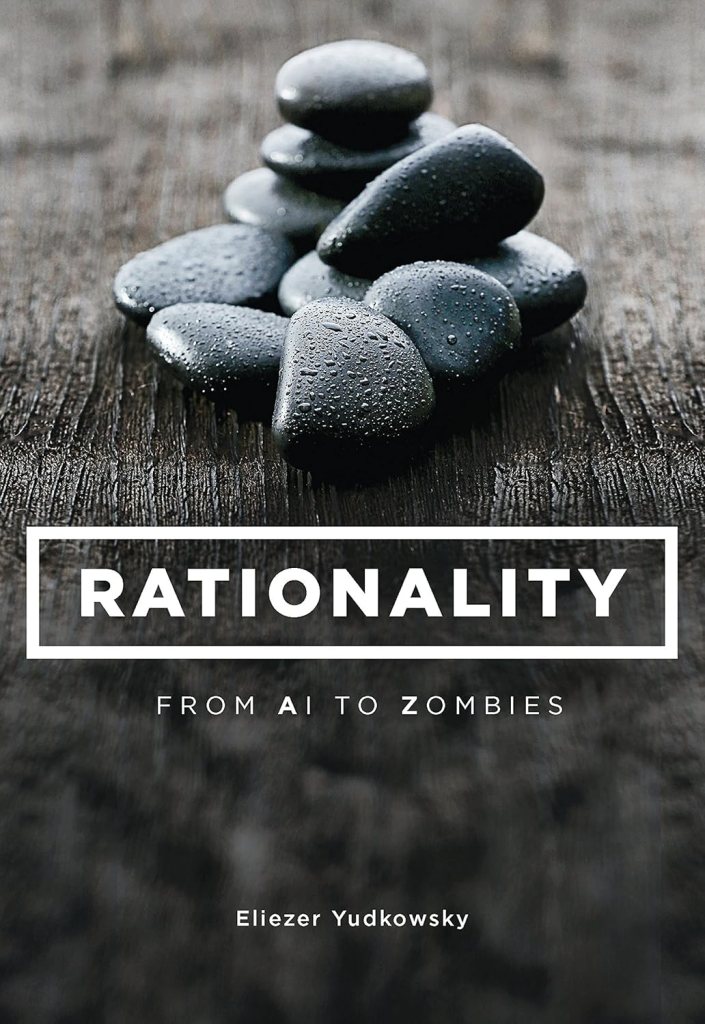
There’s a word Eliezer Yudkowsky uses early in Rationality: From AI to Zombies that I keep coming back to: Oops.
“Oops is the sound we make when we improve our beliefs and strategies; so to look back at a time and not see anything you did wrong means that you haven’t learned anything or changed your mind since then.”
It sounds almost too simple. But sit with it for a moment. If you can look back over the past year — your decisions, your assumptions, your predictions — and not find anything you got wrong, that isn’t a sign of wisdom. It’s a sign you haven’t been paying attention.
That one sentence is a better definition of intellectual honesty than anything I’ve encountered in more formal philosophy. And it sets the tone for everything that follows in this enormous, demanding, rewarding book.
What This Book Actually Is
Rationality: From AI to Zombies began as a series of blog posts on LessWrong, a community Yudkowsky founded to explore how humans can reason better. https://www.lesswrong.com/ The posts were eventually compiled into a book of over 1,800 pages — six volumes covering everything from cognitive biases to quantum mechanics to the nature of consciousness.
I’ll be honest: it’s not an easy read. Yudkowsky writes with the assumption that you are curious, that you can handle being wrong, and that you will do the work required to understand an idea rather than just memorizing its label. He is allergic to what he calls guessing the teacher’s password — reciting the right words without understanding what they point to. The whole book is a sustained attack on that habit.
But for all its scope, the book comes back to a simple question: what does it mean to think well?
Two Kinds of Rationality
Yudkowsky draws a distinction that I found clarifying. There are two separate projects that both go by the name “being rational”:
Epistemic rationality is about having accurate beliefs — building a map of reality that actually reflects the territory. Instrumental rationality is about making good decisions — winning, in the broadest sense of the word.
These are related but distinct. A person can have true beliefs and still make terrible decisions. A person can stumble into good outcomes while holding wildly inaccurate views. Yudkowsky is interested in both, but he insists they have to be built on the same foundation: probability theory for belief, decision theory for action.
“So rationality is about forming true beliefs and making winning decisions.”
Simple enough. The hard part is that our brains are not naturally equipped to do either.
The Shape of Our Mental Machinery
The early sections of the book are a tour through the cognitive bias literature — the research on how humans systematically err in predictable ways. Some of this will be familiar if you’ve read Kahneman’s Thinking, Fast and Slow, but Yudkowsky goes deeper into the implications.
A few that stuck with me:
The availability heuristic makes us judge probability by how easily examples come to mind — which means dramatic, emotionally vivid events feel more likely than mundane ones, regardless of the actual numbers.
Scope insensitivity is the finding that people’s willingness to donate money to save birds from an oil spill barely changes whether the number of birds is 2,000 or 200,000. The brain adds emotion to the problem rather than multiplying it. We respond to the image of a suffering bird, not to the scale of the problem.
“If you want to be an effective altruist, you have to think it through with the part of your brain that processes those unexciting inky zeroes on paper, not just the part that gets real worked up about that poor struggling oil-soaked bird.”
The point is not that emotions are bad. It’s that emotions evolved to handle a world of immediate, concrete, small-scale problems — and they do a poor job of scaling up to the large, abstract, statistical problems we actually face.
Beliefs as Attire
One of the sharpest ideas in the book is the distinction between beliefs you actually hold and beliefs you wear.
Some beliefs function as tribal badges. Their purpose isn’t to model reality — it’s to signal membership in a group. And because their purpose isn’t epistemic, they are immune to evidence. You can’t update a belief by pointing to facts if the belief was never about facts in the first place.
This is what Yudkowsky means when he says politics is the mind-killer. Political beliefs, for most people, function as attire — held with the full emotional intensity of tribal identity. Pointing out that you’re wrong isn’t received as useful information; it’s received as an attack.
I found myself thinking about this long after I put the book down. How many of my own beliefs are really models of the world, and how many are things I wear because of who I am and who I want to be seen as? It’s an uncomfortable question, and that discomfort is probably a good sign.
The Sound of Learning
The section I keep returning to is on what Yudkowsky calls the epistemics of error — how to handle being wrong.
Most of us are skilled at admitting small mistakes. We got the time of a meeting wrong; we misremembered a date; we underestimated how long a project would take (the planning fallacy, which gets its own chapter). These mistakes are easy to admit because they don’t threaten the larger structure of who we are and how we see the world.
Big mistakes are different. A big mistake — a fundamentally wrong model of something important — threatens the whole edifice. So we don’t admit it all at once. We make small local adjustments, each one just barely acceptable, until the underlying error is never quite confronted.
“Not every change is an improvement, but every improvement is necessarily a change. If we only admit small local errors, we will only make small local changes. The motivation for a big change comes from acknowledging a big mistake.”
This isn’t just intellectual advice. It has the quality of moral instruction. The willingness to say a real “Oops” — not the polite, face-saving kind, but the kind that actually changes how you see things — requires a particular kind of courage.
Tsuyoku Naritai
Near the end of the book, Yudkowsky introduces a Japanese phrase: tsuyoku naritai — “I want to become stronger.”
He contrasts this with a certain kind of false humility — the posture of admitting you’re flawed without actually intending to do anything about it. The rationalist’s alternative is not arrogance, but a genuine ongoing commitment to improvement.
“Never confess to me that you are just as flawed as I am unless you can tell me what you plan to do about it.”
This resonated with me more than almost anything else in the book. The admission of imperfection is easy. The commitment to becoming less imperfect is hard — and it’s the only version of humility that actually does anything.
A Book Worth the Effort
Rationality: From AI to Zombies is not a casual read. It rewards patience and punishes skimming. But it’s also one of the most genuinely useful books I’ve encountered — useful in the old sense of the word, meaning it actually changes how you think and act, not just what you know.
Yudkowsky’s central message is that good reasoning is a skill, not a gift. It can be learned, practiced, and improved. And the first step is noticing all the ways you’re currently doing it wrong — and letting yourself make the sound of learning.
Oops.

